Nando Metzger
Generative 3D/4D vision researcher and builder.
I build generative models for 3D and 4D scene reconstruction, and the systems that make them run. At Athlence Sports I work on multi-view 4D reconstruction and generative novel view synthesis for dynamic sports scenes. Ph.D. from ETH Zurich, with research at Google and Meta.
Background
At Athlence the work spans the whole chain: capture, calibration, scene representation and rendering. Alongside it runs a second body of work applying vision to satellite and aerial imagery, including population mapping and disaster response with the ICRC.
I did the Ph.D. in the Photogrammetry and Remote Sensing Lab. My doctoral advisors were Prof. Konrad Schindler and Prof. Devis Tuia. Before the Ph.D. I took my bachelor's and master's degrees in Geomatics Engineering at ETH Zurich, specializing in deep learning and computer vision.
I organize the ZurichAI meetups (ZurichCV, ZurichNLP, ZurichRobotics) and am a technical mentor at Hack4Good.
Experience |
 |
Founding Technical Hire, Generative 3D/4D VisionMulti-view 4D reconstruction and generative novel view synthesis for dynamic sports scenes · Zurich | since Feb 2026 |
 Imflora Lab Imflora Lab |
Chief Technology OfficerGaussian splatting pipelines for VR installations, with a three-person research and art collective | since May 2025 |
 |
Student Researcher, 3D computer visionHost: Federico Tombari · Zurich | 2025 · 8 months |
 |
Research Intern, then Research CollaboratorSeattle & Zurich | 2023–2024 · 9 months |
 |
Ph.D., Photogrammetry & Remote SensingSchindler / Tuia · Zurich | 2021–2026 |
 |
Machine Learning Engineer, part timeZurich | 2019 · 6 months |
Generative 3D & 4DGenerative models, multi-view geometry and neural rendering. * indicates equal contribution. |
|
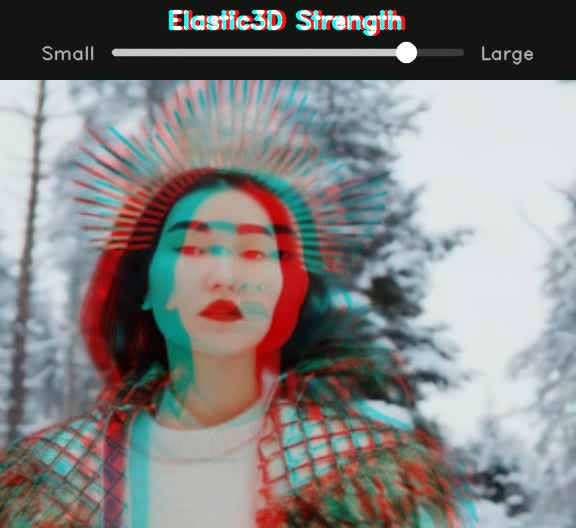
Elastic3D: Controllable Stereo Video Conversion with Guided Latent
Decoding
Nando Metzger, Prune Truong, Goutam Bhat, Konrad Schindler, Federico Tombari CVPR, 2026 (Highlight, top 3%) First author: method, implementation, and experiments. project page / arXiv / Matchability metric Elastic3D is a controllable, end-to-end method for monocular-to-stereo video conversion. Based on latent diffusion with a novel guided VAE decoder, it ensures sharp and epipolar-consistent output while allowing intuitive control over the stereo effect at inference time. |

|
Metal-Gauss 🤘: Train 3D Gaussian Splats on a Mac in Minutes
Nando Metzger GitHub Project, 2026 Sole author: Metal kernels, trainer, and benchmark harness. code Native 3D Gaussian Splatting for Apple Silicon, implemented with Metal. A fused forward+backward rasteriser compiled at runtime, so there is no CUDA and no Xcode. Across all eight NeRF-synthetic scenes it reaches 31.9 dB in about 6 minutes, where the strongest competitor needs 28 minutes to reach 29.2. Hover to watch it converge. |

|
🌼Marigold: Affordable Adaptation of Diffusion-Based Image Generators
for Image Analysis
Bingxin Ke*, Kevin Qu*, Tianfu Wang*, Nando Metzger*, Shengyu Huang, Bo Li, Anton Obukhov, Konrad Schindler IEEE Transactions on Pattern Analysis and Machine Intelligence (TPAMI), 2025 Equal contribution: led the high-resolution work. arXiv / code / demo Marigold (TPAMI) generalizes the original CVPR'24 monocular depth estimator into a diffusion-based foundation model for dense prediction, supporting tasks such as depth, surface normals, and intrinsic image decomposition with only a few diffusion steps and efficient fine-tuning. |

|
📟 PaGeR: Unified Panoramic Geometry Estimation via Multi-View
Foundation Models
Vukasin Bozic, Isidora Slavkovic, Dominik Narnhofer, Nando Metzger, Denis Rozumny, Konrad Schindler, Nikolai Kalischek arXiv preprint, 2026 project page / arXiv / code / demo / models PaGeR lifts 3D foundation models built for perspective images into the panorama domain, recovering a full 360° scene from one panoramic image. It predicts scale-invariant depth, metric depth, surface normals and sky masks in a single forward pass, zero-shot. |
|
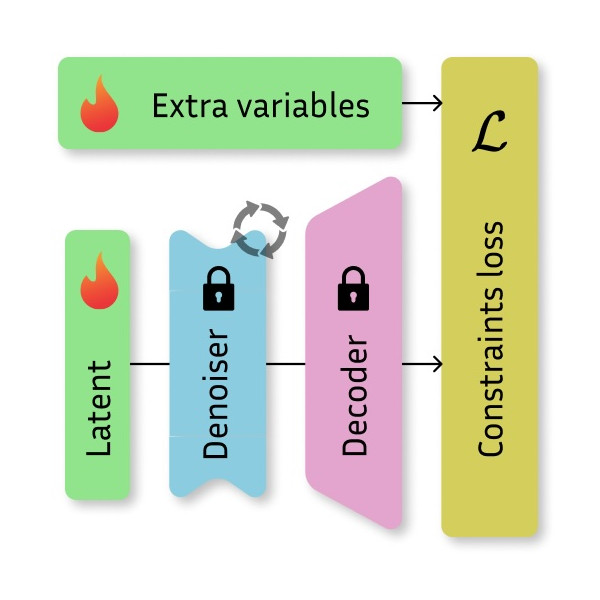
⇆ Marigold-DC: Zero-Shot Monocular Depth Completion with Guided
Diffusion
Massimiliano Viola, Kevin Qu, Nando Metzger, Bingxin Ke, Alexander Becker, Konrad Schindler Anton Obukhov, ICCV, 2025 Supervised Massimiliano Viola's master's thesis. project page / arXiv / code / demo Marigold-DC is a zero-shot depth completion framework. We repurpose Marigold as an off-the-shelf monocular depth estimator and guide it with sparse depth observations. |
|
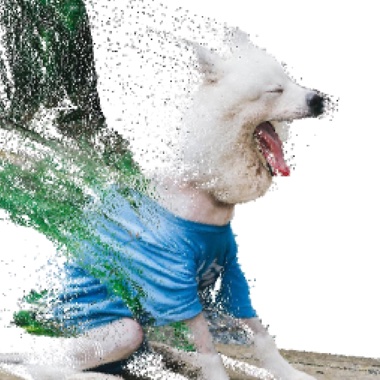
🌼Repurposing Diffusion-Based Image Generators for Monocular Depth
Estimation
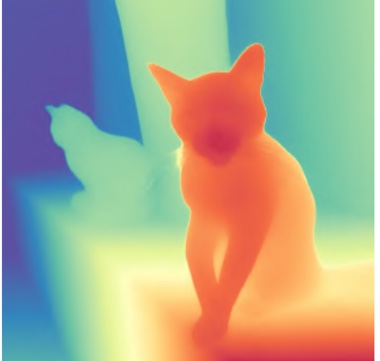
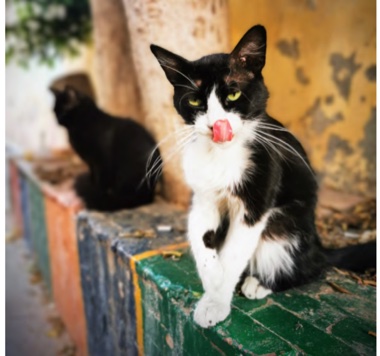
Bingxin Ke, Anton Obukhov, Shengyu Huang, Nando Metzger, Rodrigo Caye Daudt, Konrad Schindler CVPR, 2024 (Oral, Best Paper Candidate, top 0.17%) project page / arXiv / code / colab / demo Marigold is an affine-invariant monocular depth estimation method based on Stable Diffusion, leveraging its rich prior knowledge for better generalization and achieving state-of-the-art performance with significant improvements, even with synthetic training data. |
|
BetterDepth: Plug-and-Play Diffusion Refiner for Zero-Shot Monocular
Depth Estimation
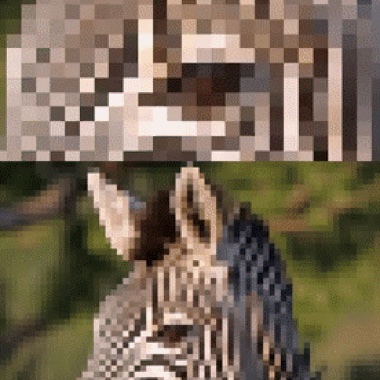
Xiang Zhang, Bingxin Ke, Hayko Riemenschneider, Nando Metzger, Anton Obukhov, Markus Gross, Konrad Schindler, Christopher Schroers NeurIPS, 2024 Paper / arXiv / project BetterDepth is a plug-and-play diffusion-based refiner that boosts the performance of any SOTA zero-shot monocular depth estimation method. |
|
🔥Thera: Aliasing-Free Arbitrary-Scale Super-Resolution with Neural
Heat Fields
Alexander Becker, Rodrigo Caye Daudt, Dominik Narnhofer, Torben Peters, Nando Metzger, Jan Dirk Wegner, Konrad Schindler Transactions on Machine Learning Research (TMLR), 2025 project page / arXiv / code Neural heat fields model a physically exact point spread function, giving analytically correct anti-aliasing at any scale at no extra cost. Thera turns this into aliasing-free arbitrary-scale super-resolution while staying parameter-efficient. |
|
🦌DADA: Guided Depth Super-Resolution by Deep Anisotropic
Diffusion
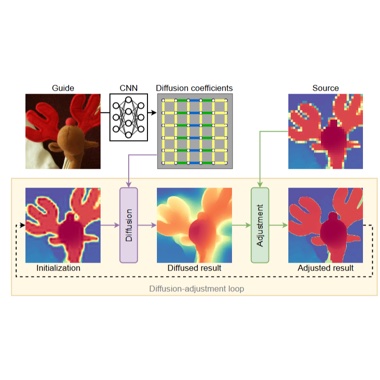
Nando Metzger*, Rodrigo Caye Daudt*, Konrad Schindler CVPR, 2023 arXiv / paper / project page / video / poster We propose DADA, a novel approach to depth image super-resolution by combining guided anisotropic diffusion with a deep convolutional network, enhancing both edge detail and contextual reasoning. This method achieves unprecedented results in three benchmarks, especially at larger scales like x32 |

|
ML-Bokeh: Monocular View Synthesis with Cinematic Depth-of-Field
Nando Metzger GitHub Project, 2025 code ML-Bokeh extends the SHARP codebase with physically-based rendering and smart autofocus for cinematic depth-of-field effects. It features synthetic aperture simulation, artifact-free spiral sampling, and an automated autofocus system based on subject detection. |
|
MLFocalLengths: Estimating the Focal Length of a Single Image
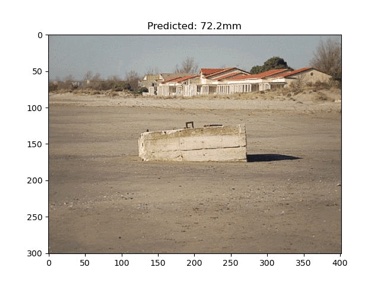
Nando Metzger GitHub Project, 2023 code Focal length is often missing from internet photos and absent from vintage ones. Recovering it from a single view is ill-posed and needs scene understanding, so I trained a model to predict it and open-sourced the weights. |
Earth observation & humanitarian responseVision applied to satellite and aerial imagery, including work with the ICRC on population mapping and disaster response. |
|
🍿POPCORN: High-resolution Population Maps Derived from Sentinel-1 and
Sentinel-2🛰️
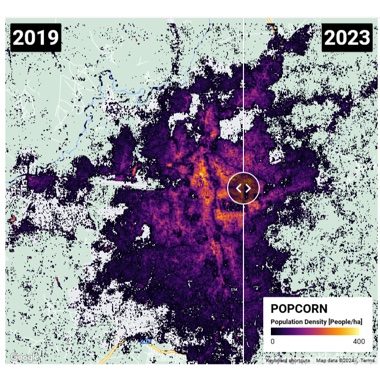
Nando Metzger, Rodrigo Caye Daudt, Devis Tuia Konrad Schindler Remote Sensing of Environment, 2024 project page / code / arXiv / demo / data POPCORN is a lightweight population mapping method using free satellite images and minimal data, surpassing existing accuracy and providing interpretable maps for mapping populations in data-scarce regions. |
|
🟡POMELO: Fine-grained Population Mapping from Coarse Census Counts and
Open Geodata
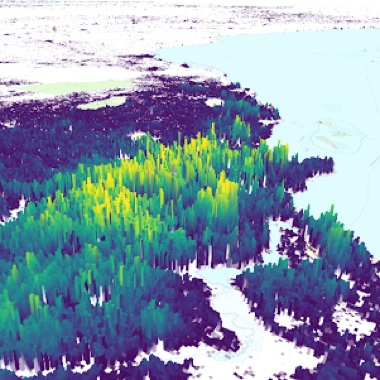
Nando Metzger, John E Vargas-Muñoz, Rodrigo Caye Daudt, Benjamin Kellenberger, Thao Ton-That Whelan, Muhammad Imran, Ferda Ofli, Konrad Schindler, Devis Tuia Nature - Scientific Reports, 2022 code / video / arXiv / community dataset POMELO is a deep learning model that creates fine-grained population maps using coarse census counts and open geodata, achieving high accuracy in sub-Saharan Africa and effectively estimating population numbers even without any census data. |
|
The Potential of Copernicus Satellites for Disaster Response:
Retrieving Building Damage from Sentinel-1 and Sentinel-2
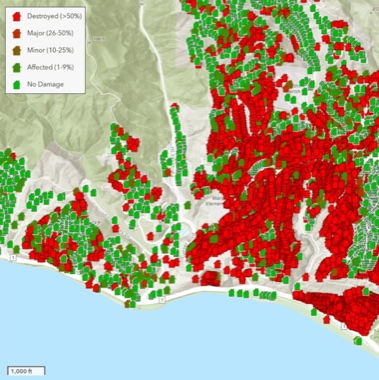
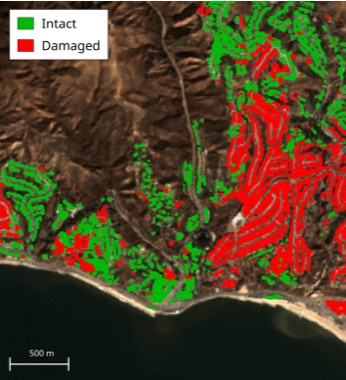
Olivier Dietrich, Merlin Alfredsson, Emilia Arens, Nando Metzger, Torben Peters, Linus Scheibenreif, Jan Dirk Wegner, Konrad Schindler ISPRS Congress, 2026 paper / DOI / arXiv / code We investigate whether medium-resolution Copernicus Sentinel-1 and Sentinel-2 imagery can support rapid building damage assessment after disasters. We introduce the xBD-S12 dataset and show that, despite 10 m resolution, building damage can be mapped reliably across many events, making Copernicus data a practical complement to limited very-high resolution imagery. |
|
Bourbon 🥃: Distilled Population Maps
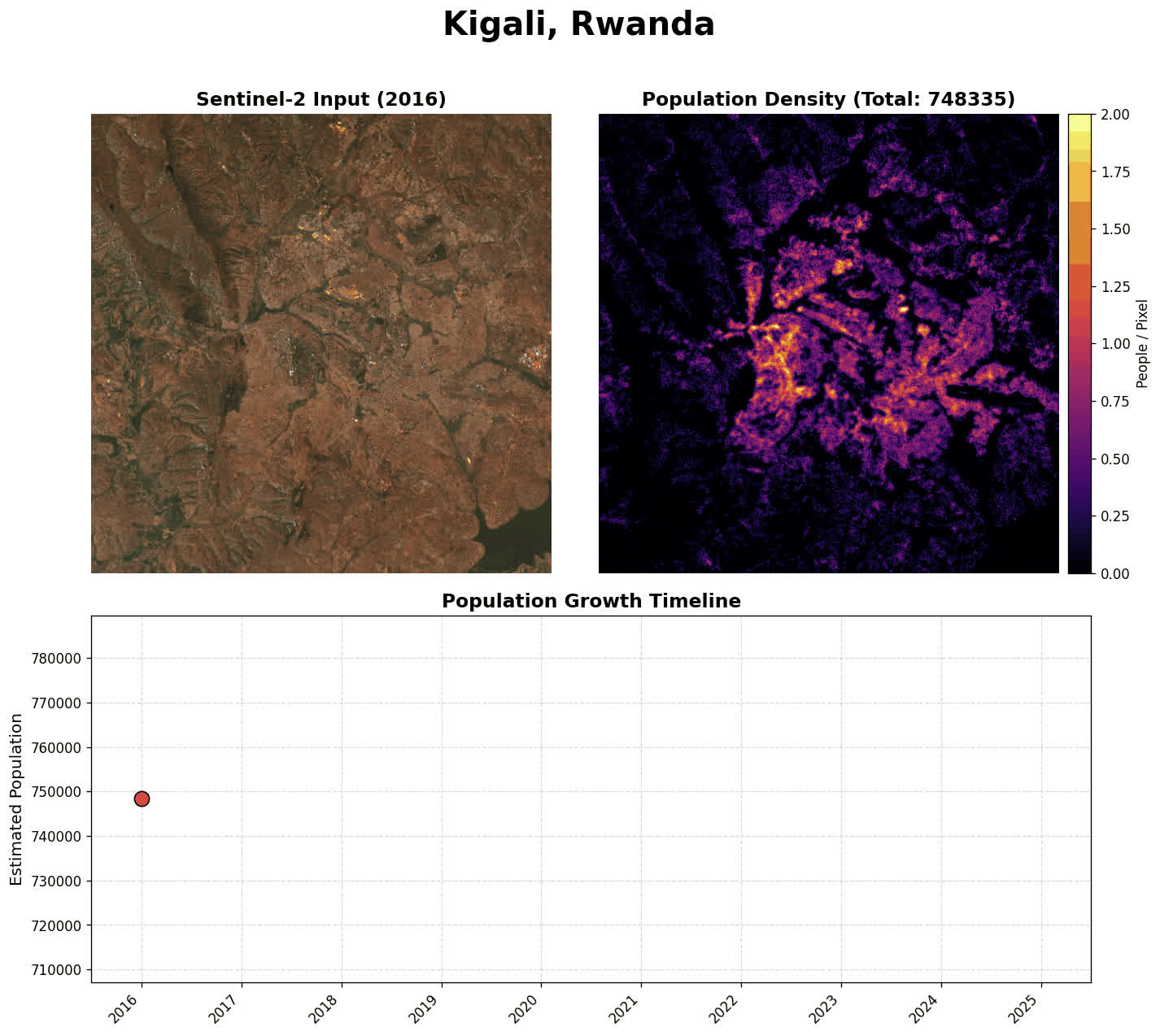
Nando Metzger GitHub Project, 2026 code A lightweight, distilled version of POPCORN that estimates population from Sentinel-2 imagery alone, compact enough for fast large-scale inference. An all-in-one version fetches the imagery and runs the model in a single command. |
|
Crop Classification under Varying Cloud Cover with Neural Ordinary
Differential Equations
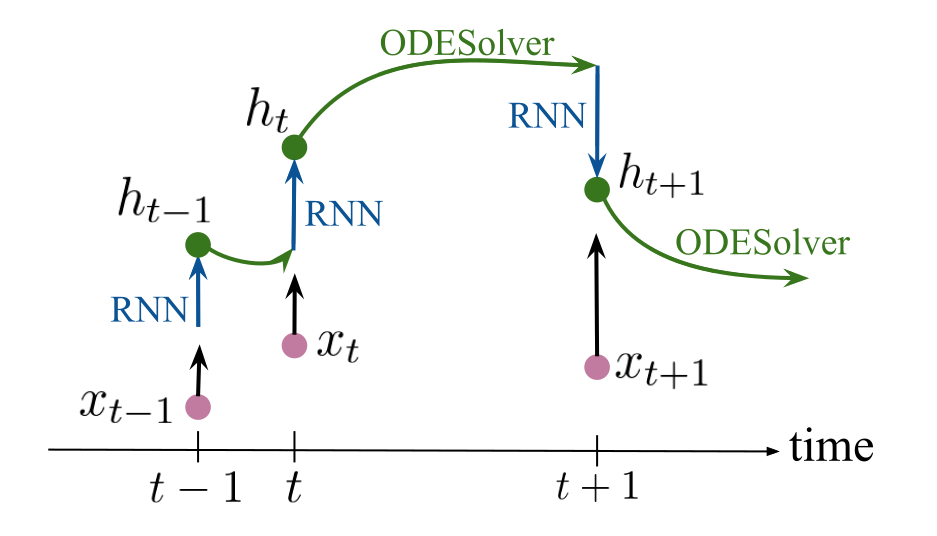
Nando Metzger*, Mehmet Ozgur Turkoglu*, Stefano D'Aronco, Jan Dirk Wegner, Konrad Schindler, IEEE, TGRS, 2021 paper / DOI / arXiv / code We propose using neural ordinary differential equations (NODEs) combined with RNNs to improve crop classification from irregularly spaced satellite images, showing enhanced accuracy over common methods, especially with few observations, and better early-season forecasting due to the continuous representation of latent dynamics. |
|
Four decades of circumpolar super-resolved satellite land surface
temperature data
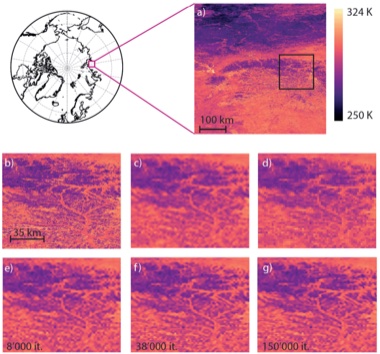
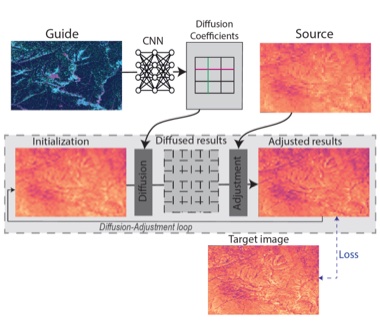
Sonia Dupuis, Nando Metzger, Konrad Schindler, Frank Göttsche, Stefan Wunderle arXiv, 2025 arXiv A 42-year pan-Arctic land surface temperature record, downscaled from AVHRR GAC to 1 km with a deep anisotropic diffusion model guided by land cover, elevation and vegetation height. The twice-daily 1 km series extends climate monitoring into the pre-MODIS era. |
|
🏗️ Urban Change Forecasting from Satellite Images
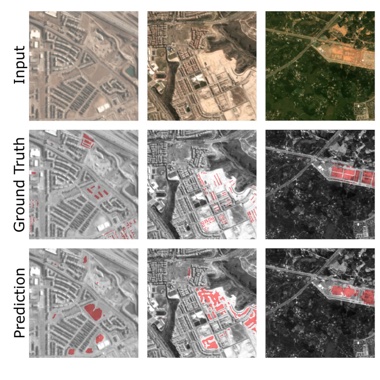
Nando Metzger, Mehmet Ozgur Turkoglu Rodrigo Caye Daudt, Jan Dirk Wegner, Konrad Schindler, PFG, 2023 (Karl Kraus Award, 1st place) paper We propose a method for forecasting the emergence and timing of new buildings using a deep neural network with a custom pretraining procedure, validated on the SpaceNet7 dataset. |
|
Automatic Image Compositing and Snow Segmentation for Alpine Snow Cover
Monitoring
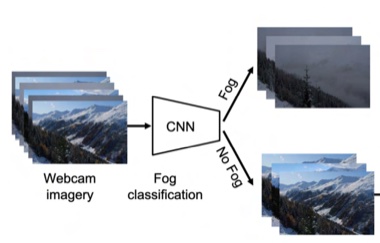
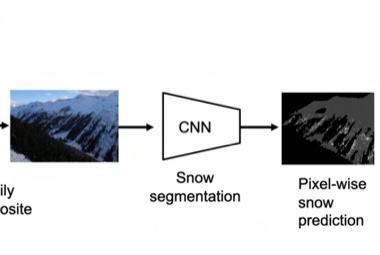
Janik Baumer, Nando Metzger, Elisabeth D Hafner, Rodrigo Caye Daudt, Jan Dirk Wegner, Konrad Schindler IEEE Swiss Conference on Data Science (SDS), 2023, paper Automates SLF's ground-based snow monitoring in the Dischma valley, pairing deep fog classification with pixel-wise snow segmentation. It removes manual thresholds and generalises across cameras, supporting avalanche research and satellite validation. |
|
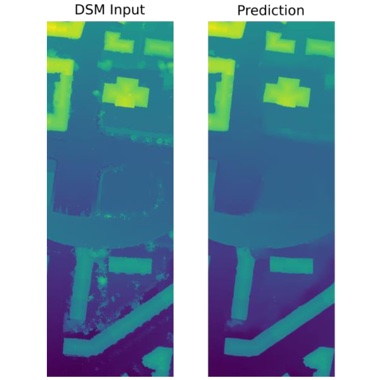
DSM Refinement with Deep Encoder-Decoder Networks
Nando Metzger, Corinne Stucker, Konrad Schindler, arXiv, 2020 (Karl Kraus Award, 3rd place) paper This work presents a method for automatically refining 3D city models generated from aerial images by using a neural network trained with reference data and a loss function to improve DSMs, effectively preserving geometric structures while removing noise and artifacts. |
TalksInvited talks and seminars. |
- 2025Invited talk at ZurichCV, Zurich
- 2025Humanitarian Action in the Digital Age
- 2025Helvetas, internal Big Data webinar
- 2024ETH4D General Assembly, on POPCORN and POMELO
- 2024University of Ulm, KoRaTo team, at ETH Zurich
- 2024WorldPop, Southampton, on population mapping
- 2023UZH Astrophysics Seminar · recording
- 2023Google, Semantic Perception group
- 2023Google, Open Building team
- 2023SocialIncome, on POMELO
- 2023SDG Lab workshop, Deloitte, Geneva, on POMELO
- 2022ETH Weather and Climate Risks group
- 2022ETH AI+X, on POMELO
News
Earlier news
|
Open mentoringA lot of useful advice in research never gets written down. It travels through networks that not everyone has access to. I keep time aside for short, informal conversations with students and early-career researchers: picking a research direction, moving between industry and academia, or working out a sensible next step. If that would be useful, email me a few lines about your background and what you would like to talk through. |
ContactHappy to talk about generative 3D/4D reconstruction, neural rendering, or building research systems that ship. ***@***.com [reveal] / GitHub / LinkedIn / Google Scholar |
|
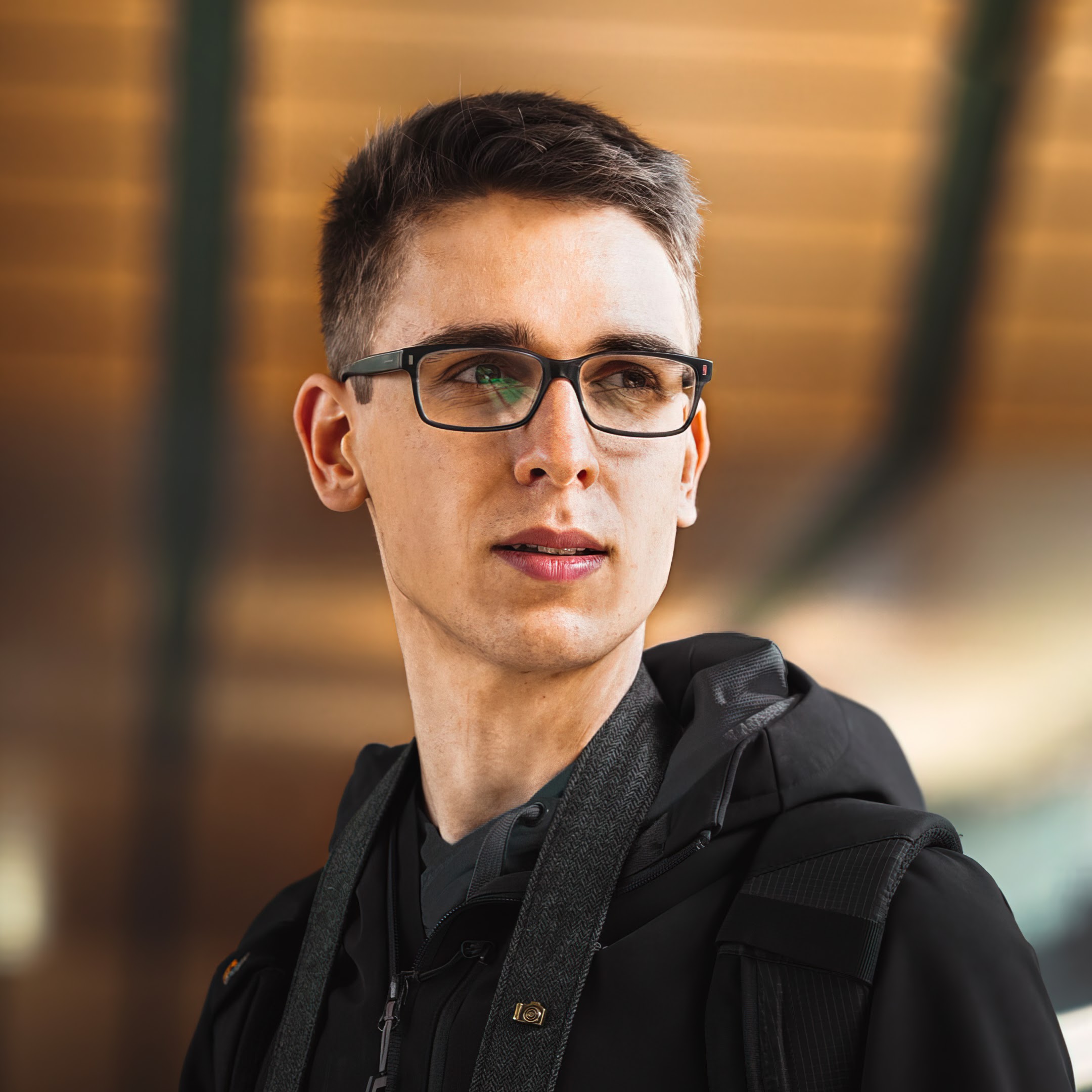
The portrait is a 3D reconstruction. It follows the pointer, and dragging it pulls
focus through a synthetic aperture: 576 pre-rendered views for the parallax, and a rack
of focus steps whose depth of field is drawn from the predicted depth map.
SHARP predicts the Gaussians from one
photograph and
metal-gauss renders them on
Apple Silicon.
|